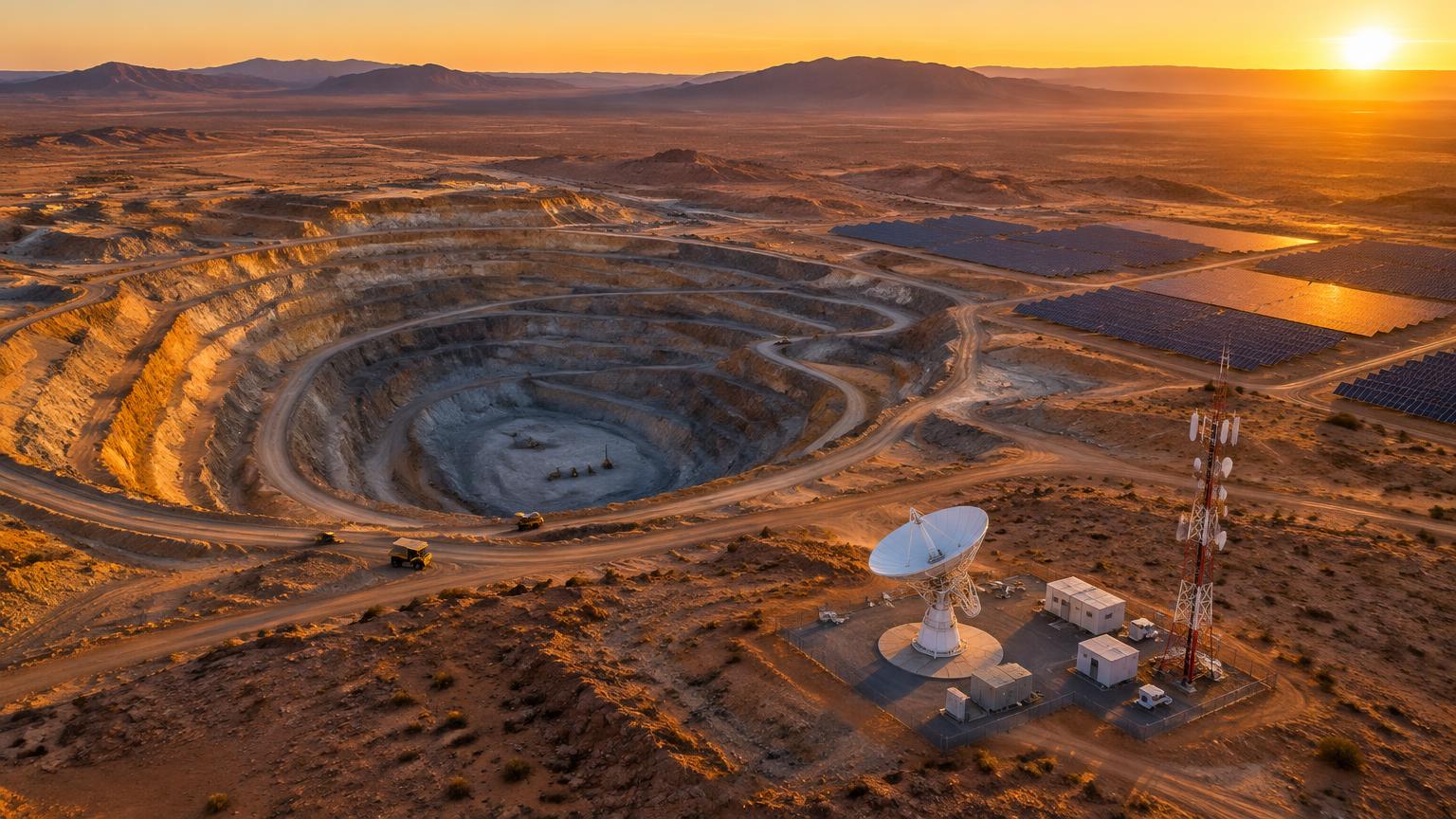
The global demand for minerals and energy is driving production into hostile, remote environments. In these isolated locations, connectivity is the operation's fundamental nervous nervous system. A communication breakdown leads to production halts, safety breaches, and financial losses.
Today, remote sites require high-performance, resilient connectivity to remain competitive and safe. This article examines the core challenges of remote industrial connectivity and the modern satellite-based solutions that are successfully overcoming them for global industrial players.
The Logistical Barrier of Terrestrial Infrastructure
For most remote sites, terrestrial solutions like fiber optics are physically and economically unviable. Deploying thousands of kilometers of fiber through rugged mountains or deserts presents astronomical costs and logistical nightmares that most companies cannot justify.
Consequently, many sites operate in a 'connected vacuum,' relying on fragmented systems that cannot support data-heavy applications. This lack of unified infrastructure limits the ability to centralize operations and implement site-wide safety protocols, hindering overall operational efficiency and growth.
Moreover, the environmental impact of terrestrial infrastructure cannot be ignored. Laying cables through sensitive ecosystems often triggers lengthy assessments and litigation. Satellite solutions bypass these footprints entirely, providing a 'zero-trench' alternative that respects local biodiversity while delivering high-speed connectivity to areas where traditional construction would be ecologically catastrophic.
Technical Challenges: Latency and Bandwidth
Beyond deployment, remote sites face technical hurdles. Legacy satellite systems often suffer from high latency and limited bandwidth, which are incompatible with modern Industry 4.0 requirements. Latency is critical for autonomous machinery where delays can be dangerous.
Furthermore, the lack of low-latency communication hampers the ability of onsite teams to collaborate with remote experts. In a critical failure scenario, the ability to stream live video to a specialist can reduce downtime from days to hours, requiring high bandwidth.
Impact on Automation
Automation relies on a continuous, low-latency feedback loop. If the connection lags, automated systems trigger emergency shutdowns, leading to significant downtime. Robust connectivity is the primary enabler of modern autonomous industrial operations.
Data Bottlenecks in IoT
Modern mines use sensors to monitor air quality and equipment health. Without sufficient bandwidth, this data is stored locally rather than analyzed in real-time, preventing immediate operational adjustments and reducing the effectiveness of the IoT ecosystem.
Modern Solutions: HTS and Multi-Orbit Networks
High Throughput Satellite (HTS) technology and Low Earth Orbit (LEO) constellations have revolutionized remote industrial connectivity. HTS provides capacity rivaling terrestrial fiber, enabling data-intensive applications like remote diagnostics and real-time site mapping.
Multi-orbit strategies—combining geostationary HTS with LEO constellations—offer the best of both worlds. This hybrid approach ensures that mission-critical, low-latency traffic is handled by LEO satellites, while large-scale data transfers use HTS capacity, providing redundancy and peak performance.
The emergence of software-defined satellites (SDS) further enhances this flexibility. Unlike traditional hardware-fixed satellites, SDS can reconfigure their coverage areas and beam capacity in real-time based on fluctuating demand. This allows operators to scale their bandwidth dynamically during peak exploration phases, ensuring that resources are never wasted on idle capacity while critical areas remain underserved.
Security and Resilience in Remote Operations
In the energy and mining sectors, data security is paramount. Remote sites are often part of critical infrastructure, making them targets for cyber-attacks. Modern satellite solutions incorporate advanced encryption to ensure that industrial data remains secure from end to end.
Resilience is achieved through software-defined networking, allowing for automatic failover between different satellite links. This ensures the site remains 'always-on,' even if part of the network fails due to atmospheric conditions or technical issues.
Physical security of the ground infrastructure is equally vital. In remote regions, terminals are vulnerable to environmental extremes and physical tampering. Hardened enclosures with integrated monitoring protect against overheating in desert climates. These enclosures also incorporate tamper-evident sensors that alert security teams to unauthorized access, providing a comprehensive defensive layer for the primary communication link.
Cybersecurity at the Edge
Protecting the network edge requires integrated security protocols that can detect and mitigate threats in real-time without manual intervention, ensuring that remote assets remain protected even when isolated from main corporate IT teams.
Resilient Network Architecture
By utilizing multiple satellite constellations, sites can maintain connectivity during severe weather or hardware failures. This level of resilience is essential for maintaining production schedules and ensuring the safety of workers in extreme environments.
Conclusion
The challenge of connecting remote mining and energy sites is no longer an insurmountable barrier to excellence. By leveraging advancements in satellite technology, operators can transform remote assets into efficient, data-driven hubs integrated with global operations.
LEVIN'S SWISSLOGISTICS International specializes in the design and management of these complex industrial networks. We provide high-performance satellite solutions engineered for remote mining and energy operations, ensuring your data flows securely and your sites remain productive.